
Recent Most Popular
-
Akraino Edge Stack , a Linux Foundation project initiated by AT&T and Intel, intends to develop a fully integrated edge infrastructur...
-
White paper vindictively stress on convergence for 5G step wise growth and strategical adoption. Convergence, not only aggregation at acce...
-
 "Next generation" capabilities have been achieved by all products in the enterprise network firewall market, and v...
 -
WiFi_in right perpectives_2018 from Saurabh Verma
-
 WBA has organized the City Wi-Fi Roaming trial under the World Wi-Fi Day initiatives across many cities since 2016. The City Wi-Fi Roamin...
 -
This tutorial guides you how firewall works in Linux Operating system and what is IPTables in Linux? Firewall decides fate of packets ...
-
 mail from mojo below...... Dear Mojo customers and partners, I have some exciting news that I am pleased to share with you. Arista Net...


Showing posts with label 5G. Show all posts
Showing posts with label 5G. Show all posts
Tuesday, 5 February 2019

Thursday, 24 January 2019
Tuesday, 22 January 2019
5G Rationales and Strategic Insights - just to fathom emerging 5G in a perspective.
White paper vindictively stress on convergence for 5G step wise growth and strategical adoption. Convergence, not only aggregation at access but a holistic approach and ONAP going to be the platform to make it a success. ONAP is being joined by almost all the major operators now.
Interestingly we released the paper at beginning of year 2018 with name '5G in apprehension - beginning of new era' and later rectified it with some 5G deployment cases and emerging strategies.
It becomes more relevant today as AT&T discloses it's 5G strategy, why read the paper below for that -
Friday, 18 January 2019
Why India should not go with the global wind of shortcoming with Chinese vendors like Huawei and ZTE.

Amidst the much hype of 5G and intense attempts to thwarts the challenges around and gain the leads, there are interesting insights to be watched and allude for.
I took some in context of Indian turmoil to include Huawei and ZTE in its 5G test bed plan.
There are few industry cues to go with Huawei on 5G, or in general for Chinese vendors.
1. 5G has been there across global in a very limited capacity so far, see the commercial deployment of 5G from Verizon and AT&T and SK Telecom and even the upcoming test beds, all have been in constrained and limited scope.
2. All 5G commercial deployment have been with rigorous criticism, like for Verizon home broadband service severely criticized by T-mobile CEO Mr Legere as "fake 5G". As it was on proprietary 5G standards based on Verzon 5G Technical Forum. Also the 5G Which came through AT&T is also under criticism as AT&T shown it with logo of '5G Evolution' not a clear 5G. Both vendors seems to be running on Samsung or Ericsson based equipment.
3. 5G Demonstration from Huawei has been at par with standards in comparison to others, Huawei leadership has been well recognized as BT Chief architect has already praised Huawei capabilities on 5G.
BT Chief architect Neil McRae on Huawei capabilities and readiness in Global mobile broadband conference.
"I've been to Shenzhen recently [Huawei's headquarters] and there's nowhere else in the world where you can see" the kind of 5G technology developments that Huawei has achieved, he noted during a panel discussion, though without highlighting any specific advances.
"The other suppliers need to learn from Huawei -- the others are held back by old telco issues," he added.
Not only Huawei but ZTE has also gone side by side with its remarkably innovative streak for 5G E2E Solution like FlexE for backhaul and X-haul kind solution and 5G Converge core for 5G core network solution. Apart from that ZTE solution also enabled pre-commercial rollout on 5G in Europe etc.
ZTE, in partnership with Wind Tre and Open Fiber, accomplished Europe's first pre-commercial 5G network in October 2017, symbolizing a major step forward for 5G commercial deployment in Europe.
ZTE seems to be first who satisfied IMT2020 for 5G core networks.
ZTE's latest version of 5G core network is developed in compliance with 3GPP Release-15 specifications released in September 2018. By adopting SBA, micro-service components and network slicing, ZTE's 5G core network can achieve flexible and agile service innovation.
ZTE recently announced successful 5G call with Chinese service provider china unicom.
4. 5G Ecosystem is in complete flow with Chinese vendors and Chinese innovation, Qualcomm investment wings has recently announced to fund Chinese innovative venture Baicell. Altogether global ecosystem does not take Chinese vendors in dissolute.
5. In an interesting move from Verizon CTO Mr Kely malady, where he recognized that true 5G has yet to evolve and hype around 5G is over hyped, as technology has not been in place in its true form. As per him, more has to come and 5G name need to be reserved for that.
"The potential to over-hype and under-deliver is a temptation the industry must resists," said Malady
6. T-mobile and Sprint also been reluctant to hype around 5G so far, in fact T-mobile CEO Mr legere called the current 5G as "fake 5G". And their debut on 5G has been around their existing infrastructures and with low spectrum band i.e. 700 MHz and 2100 MHz.
7. There was some interesting insights on 5G that could be conduced when Vodafone India CTO speak about 5G readiness as a software upgrade only.
Among these all, which i refer to as cues around 5G progress and roll outs with commercials, pre-commercials and even test beds plans. Recent outspoken statement from Huawei CEO Mr Ren Zhengfei made the dust clear.
"I personally would never harm the interest of my customers and me and my company would not answer to such requests," Ren said, as reported by Fox Business.
As reported by CNBC, he told the assembled journalists at Huawei's headquarters in Shenzen, China, that "when it comes to cyber security and privacy protection, we are committed to be sided with our customers. We will never harm any nation or any individual.
India has been in on and off situation while taking Huawei and ZTE for its 5G Test bed considerations. Whereas Indian Telecom export specific organization came up with strict restriction on Chinese vendors, but department of telecom and ministry of telecom given a separate stand after initial tussles - and given Huawei a green flag, though ignored ZTE.
Reason behind accepting Huawei by Indian telecom ministry could not only technical or based on security assessments, but political as well. But as an industry observer, I corroborate with the decision here and even want to extend it further like for ZTE as well.
Chinese vendors can not be ignored by the massive economy like India, as well as Indian service providers are also in likely hood for them. As Indian Cellular operator association chief Mr matthew has also expressed interest of cellular industry of India in favor of Chinese vendors. This all are due to valid reasons of their capability and suiting prices.
These view are based on industry observation and from Saurabh Verma, Chief technology Consultant, Fundarc Communication (xgnlab).
Wednesday, 14 November 2018
Sunday, 4 November 2018
Sunday, 14 October 2018
Massive MIMO Beamforming - from Keysight
Massive MIMO (mMIMO) and beamforming are buzzwords widely used in the telecom industry when referring to 5G and latest advancements of LTE. The challenge is that MIMO comes in many different variants, some of them having been in use already for years in legacy LTE networks.
SU-MIMO vs. MU-MIMO
In legacy LTE, the term MIMO usually refers to Single User MIMO (SU-MIMO). In Single User MIMO, both the base station and UE have multiple antenna ports and antennas, and multiple data streams are transmitted simultaneously to the UE using same time/frequency resources, doubling (2×2 MIMO), or quadrupling (4×4 MIMO) the peak throughput of a single user.
In MU-MIMO, base station sends multiple data streams, one per UE, using the same time-frequency resources. Hence, MU-MIMO increases the total cell throughput, i.e. cell capacity. The base station has multiple antenna ports, as many as there are UEs receiving data simultaneously, and one antenna port is needed in each UE.
Beamforming – principle of operation
Terms beamforming and mMIMO are sometimes used interchangeably. One way to put it is that beamforming is used in mMIMO, or beamforming is a subset of mMIMO. In general, beamforming uses multiple antennas to control the direction of a wave-front by appropriately weighting the magnitude and phase of individual antenna signals in an array of multiple antennas. That is, the same signal is sent from multiple antennas that have sufficient space between them (at least ½ wavelength). In any given location, the receiver will thus receive multiple copies of the same signal. Depending on the location of the receiver, the signals may be in opposite phases, destructively averaging each other out, or constructively sum up if the different copies are in the same phase, or anything in between. Beamforming is further divided to subcategories as explained as below...

Digital beamforming (aka. Baseband beamforming, aka precoding)
The signal is pre-coded (amplitude and phase modifications) in baseband processing before RF transmission. Multiple beams (one per each user) can be formed simultaneously from the same set of antenna elements. In the context of LTE/5G, MU-MIMO equals to digital beamforming. Multiple TRX chains, one per each simultaneous MU-MIMO user, are needed in the base station. Digital beamforming (MU-MIMO) is used in LTE Advanced Pro (transmission modes 7,8, and 9) and in 5G NR. Digital beamforming improves the cell capacity as the same PRBs (frequency/time resources) can be used to transmit data simultaneously for multiple users.
Analog beamforming
The signal phases of individual antenna signals are adjusted in RF domain. Analog beamforming impacts the radiation pattern and gain of the antenna array, thus improves coverage. Unlike in digital beamforming, only one beam per set of antenna elements can be formed. The antenna gain boost provided by the analog beamforming overcomes partly the impact of high pathloss in mmWave. Therefore analog beamforming is considered mandatory for the mmWave frequency range 5G NR.
Hybrid beamforming
Hybrid beamforming combines the analog beamforming and digital beamforming. It is expected that mm-wave gNB (5G base station) implementations will use some form of hybrid beamforming. One approach is to use analog beamforming for coarse beamforming, and inside the analog beam use a digital beamforming scheme as appropriate, either MU-MIMO or SU-MIMO.
Massive MIMO
The most commonly seen definition is that mMIMO is a system where the number of antennas exceeds the number of users. In practice, massive means there are 32 or more logical antenna ports in the base station It is expected that NEMs will start with a maximum of 64 logical antenna ports in 5G.
Figure 2 illustrates how mMIMO works in practice. An antenna array of 50 omni elements, with ½ wavelength spacing in between the antenna elements is used. The 50 elements transmit 4 distinct streams of data via 4 logical antenna ports, one stream for each UE. All four streams are transmitted using the same physical resource blocks, i.e. the same time/frequency resources. The data streams do not interfere between each other because each of them has a distinct radiation pattern, where the signal strength in the direction of the target UE is optimized, and in the directions of the other UEs (victim UEs) the signal strength is minimized.

In MU-MIMO/mMIMO, the base station applies distinct precoding for the data stream of each UE where the location of the UE, as well as the location of all the other UEs, are taken into account to optimize the signal for target UE and at the same time minimize interference to the other UEs. To do this, the base station needs to know how the downlink radio channel looks like for each of the UEs.
Beam-based coverage measurements in 5G
The coverage is beam-based in 5G, not cell based. There is no cell-level reference channel from where the coverage of the cell could be measured. Instead, each cell has one or multiple Synchronization Signal Block Beam (SSB) beams, see Figure 3. SSB beams are static, or semi-static, always pointing to the same direction. They form a grid of beams covering the whole cell area. The UE searches for and measure the beams, maintaining a set of candidate beams. The candidate set of beams may contain beams from multiple cells. The metrics measured are SS-RSRP, SS-RSRQ, and SS-SINR for each beam. Physical Cell ID (PCI) and beam ID are the identifications separating beams from each other. In field measurements, these metrics can be collected both with scanning receivers and test UEs. Hence, SSB beams show up as kind of new layer of mini-cells inside each cell in the field measurements.
As can be seen from Figure 3, the different SSBs (beams) of a cell are transmitted at different times. Therefore, there is no intra-cell interference among the SSB beams, and at least the scanning receivers should be able to detect also extremely weak SSB beams, even in presence of a dominant, strong beam from the same cell. As an example, let’s imagine a place of poor dominance in an LTE network, where a scanner or a test UE detects reference signals from 6 different cells. If it were a 5G network, the device could see, for example, six beams of each sox cells, in total 36 reference signals. Provided of course that the scanner or test UE is fast enough to catch all these signals. The performance of the UEs as well as scanners is yet to be seen both in the spec sheets and in practice.

Of course, it must be kept in mind that 5G can operate without beamforming, in which case there would be one SSB beam covering the whole cell area, and all the coverage testing methodology would default back to same as in LTE as SSB beam equals to cell in that case.
How to test capacity gain of Massive MIMO
Capacity gain is achieved only when multiple UEs are generating downlink traffic simultaneously. There are many variables impacting the real-life gain provided by the mMIMO.
The spatial distribution of cell users has a big impact. Ideally, the UEs should be scattered across the cell area. If all users are packed in the same location, for example around the same table in a cafeteria, it becomes impossible to isolate the users to different beams that do not overlap. The minimum horizontal and vertical spatial separation between UEs may differ depending on the number of physical antenna elements in the gNB antenna panel in the horizontal and vertical dimensions..
The signa- to-noise-ratio of each user, as well as the multipath propagation profile impact the achievable performance. The scheduling decisions, as well as whether MU-MIMO is to be used or not, are done by every 1ms slot by the gNB. The gNB scheduling and link adaptation algorithms are proprietary, not defined in 3GPP. Hence it is an area where the network equipment manufacturers can differentiate from each other. The performance of the mMIMO has a major impact in the system capacity of the 5G network. Hence, it is in the best interest of the operators to verify the field performance of massive MIMO implementations as part of the vendor selection and network acceptance processes.
Summary
When testing the capacity gain of mMIMO, there needs to be multiple test UEs distributed in the cell area, each performing active bulk data transfer testing against a test server simultaneously. As part of the test setup, it is important to ensure that the core network and backend server have sufficient bandwidth, so that the radio interface is the only bandwidth bottleneck during the test. Multi-threaded data download can be used in the tests to remove sub-optimal impacts of TCP flow control. The different scenarios to be tested may include UEs close to each other to test the threshold spatial separation where mMIMO can still provide gain, vertical distribution of UEs (one in each floor of a high-rise building), horizontal distribution of UEs, line of sight UEs vs non-line of sight UEs with rich multipath propagation environment, cell edge vs. cell center, moving UEs, or any combination of the above.
Thursday, 9 August 2018
Is 5G really so hard to break?

5G is not a nut at all like previous Gs. 5G is a re-imagination, paradigm shifts and new vision to
accommodate certain advancements on radio and core network technologies, like
massive MIMO, SDN/NFV, VNF/Cloud and MEC. 5G is also about upcoming use
cases and capability & flexibility provided for them like IOT, Network
Slicing or Application defined networking.
By and large it’s an end-to-end overhauling with new
instruments to existing networks, which may be of concern for many reason, that
need a transformational approach. As VNF and Cloud are most obvious tools to
take up the necessary load of new functionality, MEC at the RAN level will be
pivotal to discriminate the service logics and catalyze the application specific
requirements fulfillment.
The transformation is going to shape-in with the shift in
architectural paradigms to more hybrid or heterogeneous approaches and also
leveraging the virtualization to accommodate variety of applications and use
cases like for massive IOT, public safety, HD
video, mission critical i.e. latency sensitive applications.
Mobile edge computing abbreviated as MEC is about the cloud at edge or may be related to new term called as fog computing which is about putting many of RAN specific functionalities on virtual systems which are adaptive to load and computational requirements. MEC will help to provide right orchestration for VNF kind of architecture need for End to End networking, in term of network operation and performance optimization. MEC is best for the uses cases like for content management networks, latency sensitive applications, massive access management etc.
Virtualization is the kingpin in whole 5G conception as the required flexibility of the systems and network can be provided through it and that help to accommodate the application specific configuration with the term that provide end to end re-construction i.e. it is all about network slicing. Network slicing can also be envisaged as application defined networking that is about ad-hoc re-deployment or re-configuring network in line to the specific application requirements. As per the 5G specification, this re-deployment time is not in days but in minutes and saying precisely it is 90 minutes only.
Monday, 6 August 2018
Thought to write on 5G again - Allusive or Ellusive?

Thought to write on 5G again, as 5G is still elusive in talk
and discussion. 5G is a re-imagination, paradigm shifts and new vision to
accommodate certain advancements on radio and core network technologies, like
massive MIMO, SDN/NFV, VNF/Cloud and MEC. 5G is also about upcoming use
cases and capability & flexibility provided for them like IOT, Network
Slicing or Application defined networking.
By and large it’s an end-to-end overhauling with new
instruments to existing networks, which may be of concern for many reason, that
need a transformational approach. As VNF and Cloud are most obvious tools to
take up the necessary load of new functionality, MEC at the RAN level will be
pivotal to discriminate the service logics and catalyze the application specific
requirements fulfillment.
The transformation is going to shape-in with the shift in
architectural paradigms to more hybrid or heterogeneous approaches and also
leveraging the virtualization to accommodate variety of applications and use
cases like for massive IOT, public safety, HD
video, mission critical i.e. latency sensitive applications.
Mobile edge computing abbreviated as MEC is about the cloud at edge or may be related to new term called as fog computing which is about putting many of RAN specific functionalities on virtual systems which are adaptive to load and computational requirements. MEC will help to provide right orchestration for VNF kind of architecture need for End to End networking, in term of network operation and performance optimization. MEC is best for the uses cases like for content management networks, latency sensitive applications, massive access management etc.
Virtualization is the kingpin in whole 5G conception as the required flexibility of the systems and network can be provided through it and that help to accommodate the application specific configuration with the term that provide end to end re-construction i.e. it is all about network slicing. Network slicing can also be envisaged as application defined networking that is about ad-hoc re-deployment or re-configuring network in line to the specific application requirements. As per the 5G specification, this re-deployment time is not in days but in minutes and saying precisely it is 90 minutes only.
Friday, 6 July 2018
3GPP- 5G network slicing requirements.
5G networks and network slicing
Management and orchestration of 5G networks and network slicing is a feature that includes the following work items: management concept and architecture, provisioning, network resource model, fault supervision, assurance and performance management, trace management and virtualization management aspects. With the output of these work items, SA5 provides specified management interfaces in support of 5G networks and network slicing. An operator can configure and manage the mobile network to support various types of services enabled by 5G, for example eMBB (enhanced Mobile Broadband) and URLLC (Ultra-Reliable and Low Latency Communications), depending on the different customers’ needs. The management concept, architecture and provisioning are being defined in TS 28.530, 28.531, 28.532 and 28.533.
Network slicing is seen as one of the key features for 5G, allowing vertical industries to take advantage of 5G networks and services. 3GPP SA5 adopts the network slice concept as defined in SA2 and addresses the management aspects. Network slicing is about transforming a PLMN from a single network to a network where logical partitions are created, with appropriate network isolation, resources, optimized topology and specific configuration to serve various service requirements.
As an example, a variety of communication service instances provided by multiple Network Slice Instances (NSIs) are illustrated in the figure below. The different parts of an NSI are grouped as Network Slice Subnets (e.g. RAN, 5GC and Transport) allowing the lifecycle of a Network Slice Subnet Instance (NSSI) to be managed independently from the lifecycle of an NSI.
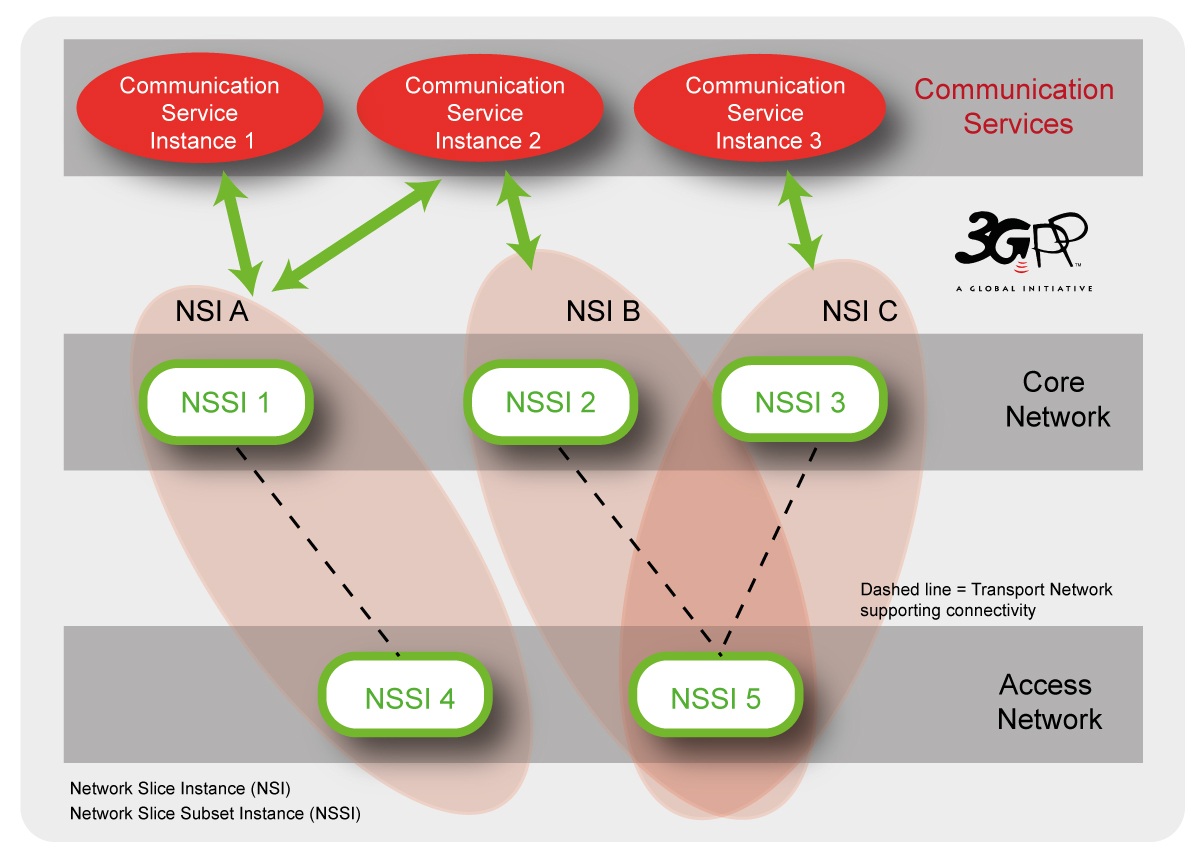
Provisioning of network slice instances
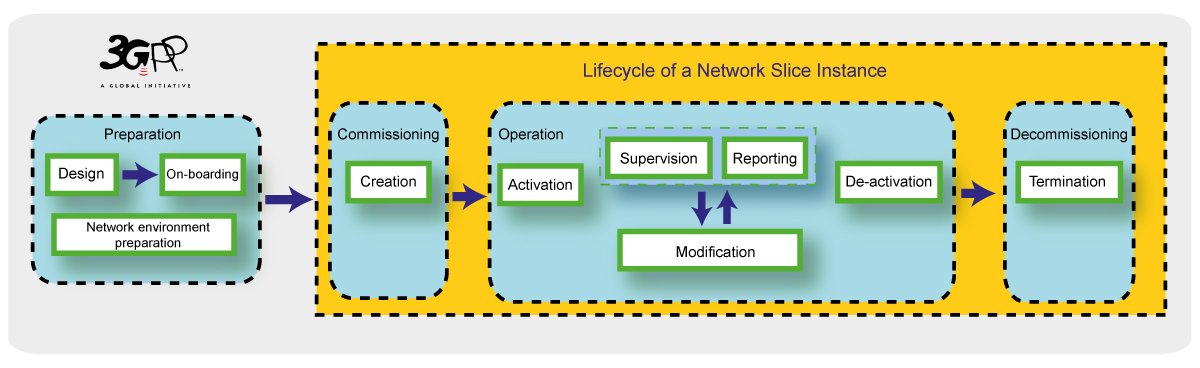
The management aspects of a network slice instance can be described by the four phases:
1) Preparation: in the preparation phase the network slice instance does not exist. The preparation phase includes network slice template design, network slice capacity planning, on-boarding and evaluation of the network slice requirements, preparing the network environment and other necessary preparations required to be done before the creation of a network slice instance.
2) Commissioning: provisioning in the commissioning phase includes creation of the network slice instance. During network slice instance creation all needed resources are allocated and configured to satisfy the network slice requirements. The creation of a network slice instance can include creation and/or modification of the network slice instance constituents.
3) Operation: includes the activation, supervision, performance reporting (e.g. for KPI monitoring), resource capacity planning, modification, and de-activation of a network slice instance. Provisioning in the operation phase involves activation, modification and de-activation of a network slice instance.
4) Decommissioning: network slice instance provisioning in the decommissioning phase includes decommissioning of non-shared constituents if required and removing the network slice instance specific configuration from the shared constituents. After the decommissioning phase, the network slice instance is terminated and does not exist anymore.
Similarly, provisioning for a network slice subnet instance (NSSI) includes the following operations:
- Create an NSSI;
- Activate an NSSI;
- De-active an NSSI;
- Modify an NSSI;
- Terminate an NSSI.
Roles related to 5G networks and network slicing
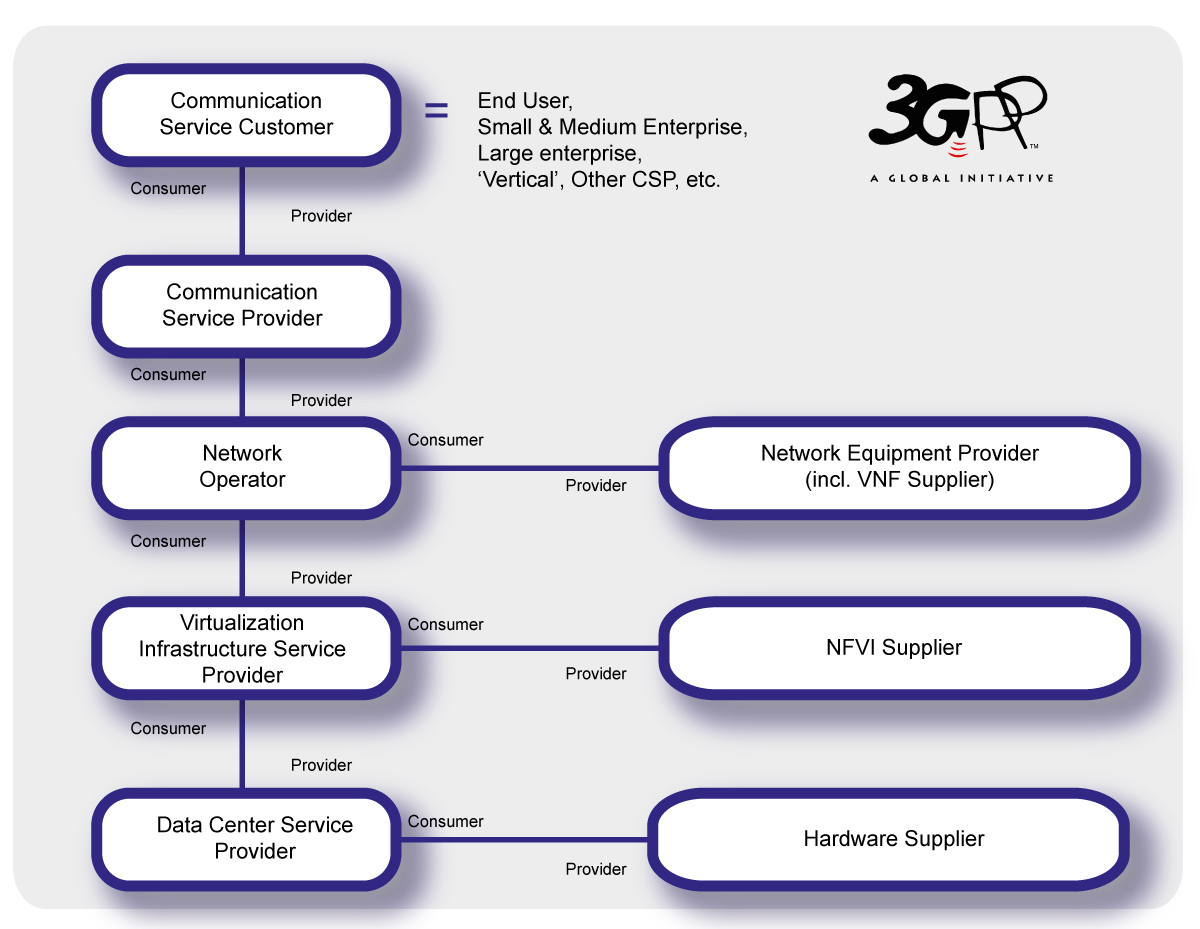
The roles related to 5G networks and network slicing management include: Communication Service Customer, Communication Service Provider (CSP), Network Operator (NOP), Network Equipment Provider (NEP), Virtualization Infrastructure Service Provider (VISP), Data Centre Service Provider (DCSP), NFVI (Network Functions Virtualization Infrastructure) Supplier and Hardware Supplier.
Depending on actual scenarios:
- Each role can be played by one or more organizations simultaneously;
- An organization can play one or several roles simultaneously (for example, a company can play CSP and NOP roles simultaneously).
Management models for network slicing
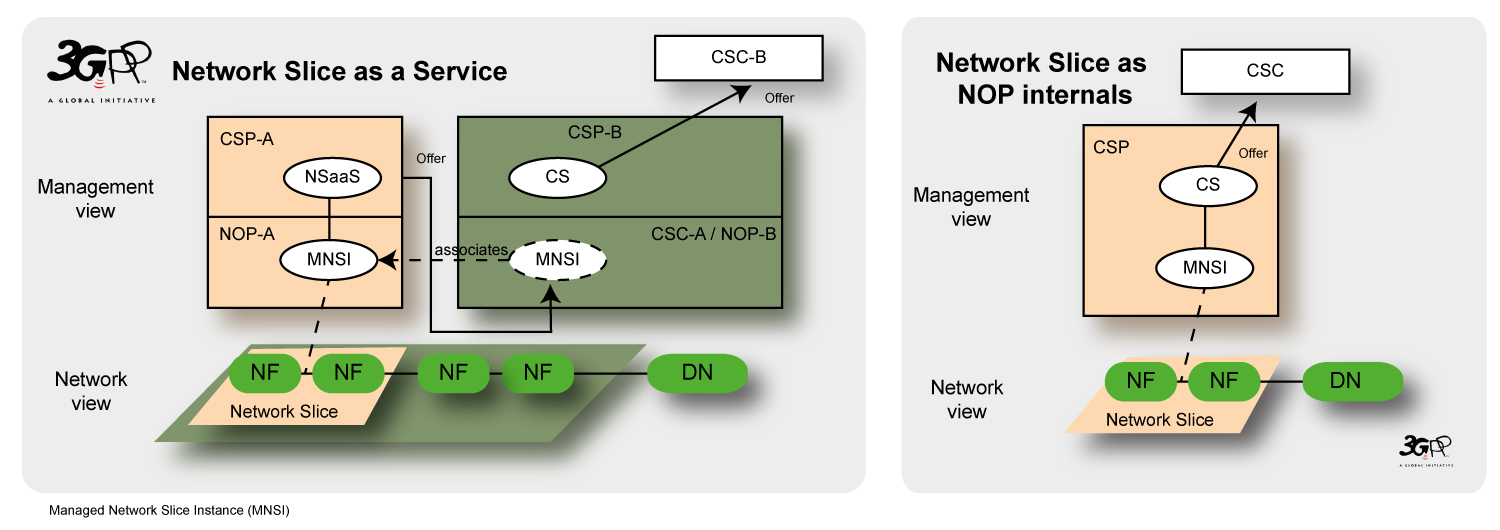
Different management models can be used in the context of network slicing.
1) Network Slice as a Service (NSaaS): NSaaS can be offered by a CSP to its CSC in the form of a communication service. This service allows CSC to use and optionally manage the network slice instance. In turn, this CSC can play the role of CSP and offer their own services (e.g. communication services) on top of the network slice instance. The MNSI (Managed Network Slice Instance) in the figure represents a network slice instance and CS represents a communication service.
2) Network Slices as NOP internals: network slices are not part of the CSP service offering and hence are not visible to CSCs. However, the NOP, to provide support to communication services, may decide to deploy network slices, e.g. for internal network optimization purposes.
Management architecture
SA5 recognizes the need for automation of management by introducing new management functions such as a communication service management function (CSMF), network slice management function (NSMF) and a network slice subnet management function (NSSMF) to provide an appropriate abstraction level for automation.
The 3GPP SA5 management architecture will adopt a service-oriented management architecture which is described as interaction between management service consumer and management service provider. For example, a management service consumer can request operations from management service providers on fault supervision service, performance management service, provisioning service and notification service, etc.
Network Resource Model (NRM) for 5G networks and network slicing
To support management and orchestration of 5G networks, the Network Resource Model (NRM) representing the manageable aspects of 5G networks needs to be defined, according to 5G network specifications from other 3GPP working groups as well as considering requirements from 5G management architecture and operations.
The 5G NRM specifications family includes 4 specifications: TS 28.540 and TS 28.541 for NRM of NR and NG-RAN, TS 28.542and TS 28.543 for NRM of 5G core network.
According to content categorization, 5G NRM specifications can be divided into 3 parts:
According to content categorization, 5G NRM specifications can be divided into 3 parts:
- Requirements, also known as stage 1,
- Information Model definitions also known as stage 2, and
- Solution Set definitions also known as stage 3.
Identified in the specifications of 5G NRM requirements (TS 28.540 and TS 28.542), the NRM of 5G network comprises NRM for the 5G core network (5GC) and NRM for 5G radio access network (i.e. NR and NG-RAN). The 5GC NRM definitions support management of 5GC Network Functions, respective interfaces as well as AMF Set and AMF Region. The NR and NG-RAN NRM definitions cover various 5G radio networks connectivity options (standalone and non-standalone radio node deployment options) and architectural options (NR nodes with or without functional split).
The 5G Information Model definitions specify the semantics and behavior of information object class attributes and relations visible on the 5G management interfaces, in a protocol and technology neutral way (UML as protocol-neutral language is used). The 5G Information Model is defined according to 5GC, NR and NG-RAN specifications. For example, in 3GPP TS 38.401, the NR node (gNB) is defined to support three functional split options (i.e. non-split option, two split option with CU and DU, three split option with CU-CP, CU-UP and DU), so in the NR NRM Information Model, corresponding Information Object Class (IOC) is defined for each network function of gNB specified, and different UML diagrams show the relationship of each gNB split option respectively. Further, in the 5G Information Model definitions, the existing Generic NRM Information Service specification (TS 28.622) is referenced to inherit the attributes of generic information object classes, and the existing EPC NRM Information Service specification (TS 28.708) is referenced for 5GS / EPS interworking relationships description.
Finally, NRM Solution Set definitions map the Information Model definitions to a specific protocol definition used for implementations. According to recommendation from TR 32.866 (Study on RESTful based Solution Set), JSON is expected to be chosen as data modelling language to describe one 5G NRM Solution Set.
Finally, NRM Solution Set definitions map the Information Model definitions to a specific protocol definition used for implementations. According to recommendation from TR 32.866 (Study on RESTful based Solution Set), JSON is expected to be chosen as data modelling language to describe one 5G NRM Solution Set.
Fault Supervision of 5G networks and network slicing
Fault Supervision is one of the fundamental functions for the management of a 5G network and its communication services. For the fault supervision of 5G networks and network slicing, the following 3GPP TSs are being specified:
1) TS 28.545 “Management and orchestration of networks and network slicing; Fault Supervision (FS); Stage 1”, which includes:
- The use cases and requirements for fault supervision of 5G networks and network slicing.
- The definitions of fault supervision related management services (e.g. NetworkSliceAlarmAcknowledgement, NetworkSliceAlarmListReading, NetworkSliceAlarmClearance, NetworkSliceAlarmNotification, NetworkSliceAlarmSubscription, etc.)
2) TS 28.546 “Management and orchestration of networks and network slicing; Fault Supervision (FS); Stage 2 and stage 3”, which includes the definition of:
- Interfaces of the fault supervision related management services; (Stage 2)
- Notifications; (Stage 2)
- Alarm related information models (e.g. alarmInformation, alarmList, etc.); (Stage 2)
- Solution set(s) (e.g. RESTful HTTP-based solution set for Fault Supervison); (Stage 3)
- New event types and probable causes if necessary.
Assurance data and Performance Management for 5G networks and network slicing
The 5G network is designed to accommodate continuously fast increasing data traffic demand, and in addition, to support new services such as IoT, cloud-based services, industrial control, autonomous driving, mission critical communications, etc. Such services may have their own performance criteria, such as massive connectivity, extreme broadband, ultra-low latency and ultra-high reliability.
The performance data of the 5G networks and NFs (Network Functions) are fundamental for network monitoring, assessment, analysis, optimization and assurance. For the services with ultra-low latency and ultra-high reliability requirements, any faults or performance issues in the networks can cause service failure which may result in serious personal and property losses. Therefore, it is necessary to be able to collect the performance data in real-time (e.g., by performance data streaming), so that the analytic applications (e.g., network optimization, SON, etc.) could use the performance data to detect any network performance problems, predict the potential issues and take appropriate actions quickly or even in advance.
For network slicing, the communication services are provided on top of the end-to-end network slice instances, so the performance needs to be monitored from end-to-end point of view.
The end to end performance data of 5G networks (including sub-networks), NSIs (Network Slice Instances) and NSSIs (Network Slice Subnet Instances) are vital for operators to know whether they can meet the communication service requirement.
The performance data may be used by various kinds of consumers, such as network operator, SON applications, network optimization applications, network analytics applications, performance assurance applications, etc. To facilitate various consumers to get their required performance data, the following items are being pursued by this WI:
- A service based PM framework and a list of PM services as described in the table below:
Management service name | Management service description |
| NF measurement job control service | The management service for creating and terminating the measurement job(s) for the NF(s). |
| NF measurement job information service | The management service for querying the information of the measurement job(s) for the NF(s). |
| NF performance data file reporting Service | The management service for reporting the NF performance data file. |
| NF performance data streaming service | The management service for providing streaming of NF performance data. |
| NSSI measurement job control service | The management service for creating and terminating the measurement job(s) for the NSSI(s). |
| NSSI measurement job information service | The management service for querying the information of the measurement job(s) for the NSSI(s). |
| NSSI performance data file reporting Service | The management service for reporting the NSSI performance data file. |
| NSSI performance data streaming service | The management service for providing streaming of NSSI performance data. |
| NSI measurement job control service | The management service for creating and terminating the measurement job(s) for the NSI(s). |
| NSI measurement job information service | The management service for querying the information of the measurement job(s) for the NSI(s). |
| NSI performance data file reporting Service | The management service for reporting the NSI performance data file. |
| NSI performance data streaming service | The management service for providing streaming of NSI performance data. |
| Network measurement job control service | The management service for creating and terminating the measurement job(s) to collect the network performance data that is not specific to network slicing. |
| Network measurement job information service | The management service for querying the information of the measurement job(s) to collect the network performance data that is not specific to network slicing. |
| Network performance data file reporting service | The management service for reporting the network performance data file that is not specific to network slicing. |
| Network performance data streaming service | The management service for providing network performance data streaming that is not specific to network slicing. |
- Performance measurements (including the data that can be used for performance assurance) for 3GPP NFs;
- End to end KPIs, performance measurements (including the data that can be used for performance assurance) for NSIs, NSSIs and networks (where the performance data is not specific to network slicing).
Subscribe to:
Posts (Atom)